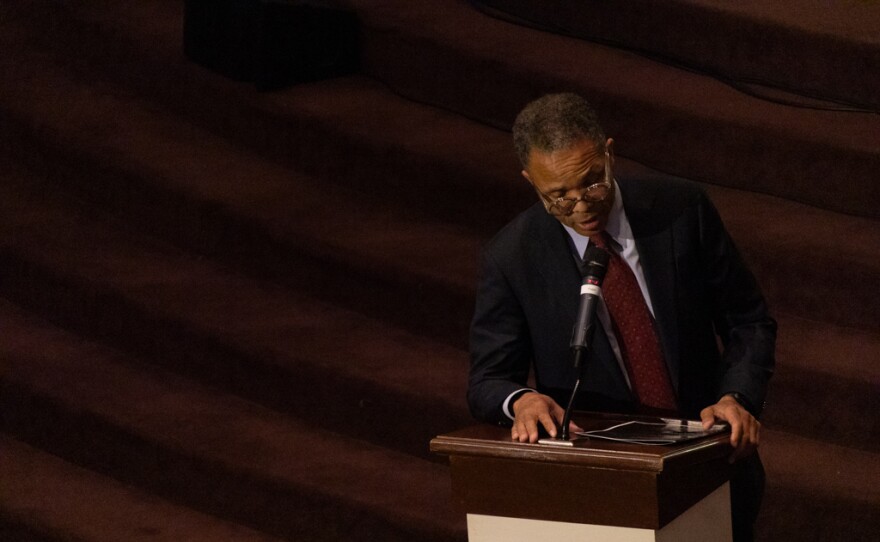
Several thousand made their way to Columbia Monday as South Carolina held memorial services in the state's capital city to honor the late Rev. Jesse Jackson.
Jackson, the civil rights trailblazer and South Carolina native son, died at 84 Feb. 17 in Chicago. The city was his longtime home. Thousands have gathered there to pay respects and console in each other's presence.
In Columbia, people holding roses and cardboard signs, along with singing choirs, greeted the arrival of Jackson's body, his family and personal friends.
Although the reverend was physically in Columbia March 2, onlookers throughout the day's services said they had always felt Rev. Jackson's presence in his home state.
From the morning
Ruth Gold, 90, was raised in the Upstate. She lived on a farm in Spartanburg before moving to Columbia for school. Gold, who is religious, felt at peace that Jackson laid to rest. And while she had no intimate interactions with Jackson or his family, she said he had instilled a specific mindset that would never leave her spirit.
"You don't give up," she said. "You fight to the end, and so that's what he did."
Greenville, where Jackson was born and grew up, nor any other part of the Upstate would hold large-scale, formal services.
It meant the services in Columbia attracted people from across the state and beyond. For some, the trip to see Jackson at rest was just a car ride away.
Elder attendees like 61-year-old Yolanda Harrison had seen Jackson twice run for president and speak with Rev. Martin Luther King Jr. She was one of the first people of the day to see the casket draped in an American flag outside of Leevy's Funeral Home, where the day's events began.
The extent of familiarity with Jackson's work varied from visitor to visitor.
Schools like the University of South Carolina, Allen University and Benedict College all have students in the Columbia area. And for these students, some of whom were born in 2008 when Barack Obama was elected the first Black President of the United States, Jackson was merely a civil rights figure learned about in a book like King or Rosa Parks.
Kaiyah Robinson, 21, said she was unfamiliar with most of Jackson's accomplishments and advocacy until the age of 20. Robinson is a choir singer at Allen University, a private historically Black university.
"Learning he worked alongside MLK was super interesting to learn about," she said.
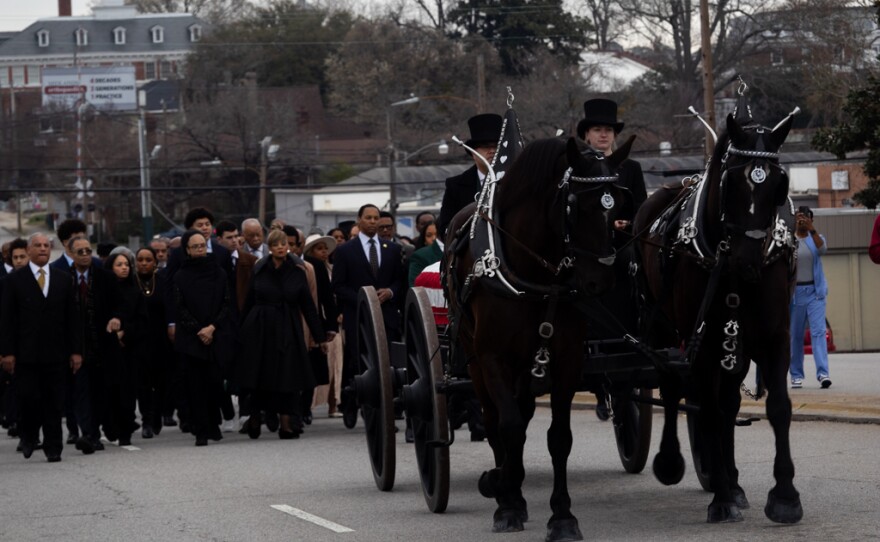
Whether people had seen Jackson in person or in a textbook, now the visitors stared at the same sight together: a horse-drawn caravan that walked Jackson's casket away from Leevy's Funeral Home.
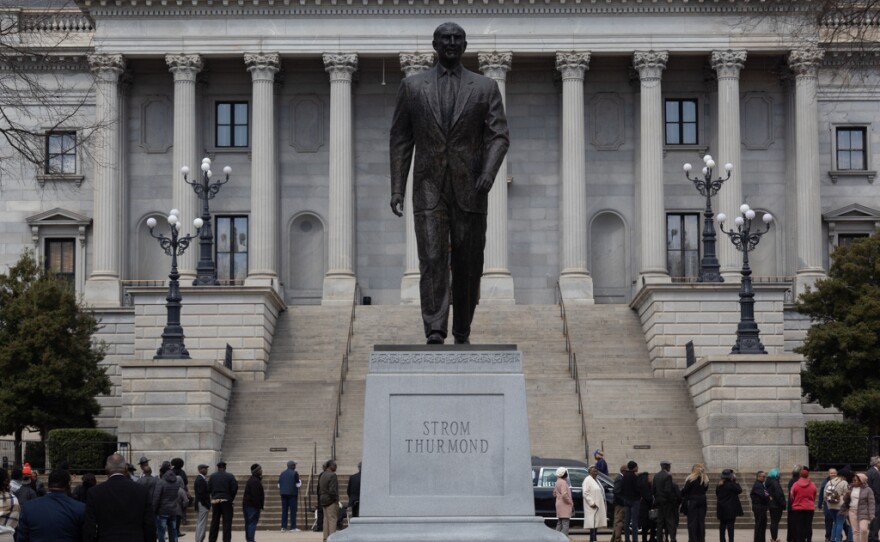
The 25-minute trek brought Jackson to the Statehouse, where he lied in state. People who wished to see Jackson lined up to enter the building. The line wrapped around the entirety of the Statehouse.


At the Statehouse
Prior to making her way inside, Dorris Wright stood by the African American History Monument on the Statehouse grounds. Wright is a longtime civil rights activist who challenged segregation at the Greenville Public Library alongside Jackson. She, Jackson and six others were arrested after staging a sit-in at the all-white main library branch.

The group became known as The Greenville Eight. And although the batch are now revered as pillars of bravery, Wright remembered a time in which she and the others were seen as disorderly public nuisances. She said it was only right for the state to honor her friend.
"I think that they really didn't have a choice — I really do because Jesse's work made South Carolina a better state," she said.
She, too, participated in a march at the Statehouse to protest against segregation and racial inequality. Students who marched in 1961 were told to do so in silence, but many broke into song, and 187 people were arrested for breach of peace in what would become the Supreme Court case Edwards v. South Carolina. Wright, who acted as a plaintiff in the case, said the initial requests of silence did not sit well with anyone.
The demonstration happened 65 years prior to the day of Jackson's services in Columbia.
Wright said Jackson was instrumental in inspiring others to act.
"Our parents could not leave their jobs. If they went out and protest, they would lose their jobs. Most of the protests were done by youth, and I'm very proud of that," she said. "And Jesse was one of those youth who led the movement."
The line to see Jackson lie in state wrapped around the entirety of the Statehouse; by 3:30 p.m., when staff at Brookland Baptist Church in West Columbia was near ready to begin celebration of life services, just half of those in line had managed to enter the building.

Charlie Tillman traveled from the Piedmont area to see Jackson lie in state. But as the line to see Jackson slithered around the Statehouse, Tillman could not bear the pain in his back. The man who traveled roughly 120 miles to the state capital decided just being in Jackson's presence was enough for him.
"The line wasn't moving, and my conditions won't allow me to stand," he said. "But I'm just glad I could make this event."



At the church
The celebration hosted a gaggle of churchgoers. Speakers like Democratic U.S. Rep. James Clyburn and Benedict College President Dr. Roslyn Artis spoke about the path Jackson helped lay out for Black people in the country. While the Statehouse services stayed somber and straightforward, Brookland Baptist Church beamed with belts of music and laughter.
Jesse Jackson Jr. spoke of family.
"We are here as a family in South Carolina because my father and my mother would have it no other way," he said.
His mother, Jacqueline Jackson, could not be present in South Carolina after falling ill. And so, it fell on Jackson Jr. to share family tributes about his father.
Cleveland Sellers, a former Voorhees University President, said Jackson's work is always remembered, but the trauma that comes with advocacy is not spotlighted nearly enough.
To close the service, Vice President of Religious Affairs and External Relations at the National Action Network Rev. Nelson Rivers spoke highly of Jackson.
"We'll never have another like him, so let us enjoy the fact that we lived when he did," he said. "So that we can tell those who come in there was none like Jesse."
Claps echoed off the church pews in appreciation, grief and gratitude. After the song "We Shall Overcome" was rendered by the Reverend Jesse L. Jackson Celebration Choir, those in attendance for the celebration of life services then headed back home.