-
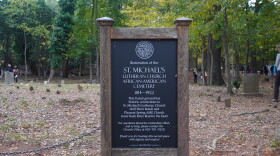 After nearly a decade of restoration, two Lexington County churches rededicated a cemetery where more than 160 people, many of them enslaved, are buried.
-
 Supporters of President Donald Trump came to Rock Hill to see him Thursday, on a visit aimed to boost the candidacy of Darline Graham for U.S. Senate. But little of the conversation was about Graham.
-
 Host Luis-Alfredo Garcia asks reporter Scott Morgan about a movement among some conservative voters to write-in U.S. Rep. Ralph Norman's name on General Election ballots instead of voting for GOP nominee Sen. Darline Graham.
-
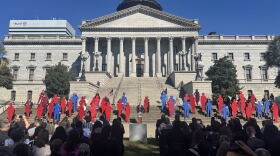 Cardboard silhouettes filled the Statehouse steps as officials, survivors and families remembered the 40 South Carolinians lost to domestic violence last year.
-
 About half of the nation's domestic violence instances go unreported, according to a U.S. Department of Justice Bureau of Justice Statistics survey. And just of fraction of the 32,338 reported in 2024 in South Carolina cases go to trial.
-
 DSS say that some of the deepest, most enduring trauma is inflicted on children who never receive a single physical mark.
-
 Domestic violence is a persistent, deadly crisis in South Carolina. New data confirm the state's rate of intimate partner violence continues to exceed the national average.
-
 James Lundy's book, The History of the Poetry Society of South Carolina: 1920 to 2021, is a chronicle of the first 100 years of the oldest state poetry society in America, the Poetry Society of South Carolina. Founded in Charleston in 1920 by DuBose Heyward, John Bennett, Josephine Pinckney, Hervey Allen, and Laura Bragg, the Society's first 101 seasons run from the Jazz Age to the COVID era, where everyone from Carl Sandburg, Edna St. Vincent Millay, Robert Frost, Robert Penn Warren, Allen Tate, Ogden Nash, Billy Collins, Sherwood Anderson, Jericho Brown, Thornton Wilder, Robert Pinsky, and hundreds of others appeared before the membership.Talking with Walter Edgar, Lundy, also currently the Society's president, gives us an insider's view, with insights into the inner workings and disfunctions of the organization and its slow progress from a Whites-only organization of the segregated South founded in the aftermath of World War I and the Spanish Flu Pandemic, through the Roaring Twenties, into the darkness of the Great Depression, World War II, a resurgence during the Atomic Age, the turbulent Sixties, the decline of Charleston, its rebound into a tourist mecca, and into the present day.
-
James Lundy's book, The History of the Poetry Society of South Carolina: 1920 to 2021, is a chronicle of the first 100 years of the oldest state poetry society in America, the Poetry Society of South Carolina. Founded in Charleston in 1920 by DuBose Heyward, John Bennett, Josephine Pinckney, Hervey Allen, and Laura Bragg, the Society's first 101 seasons run from the Jazz Age to the COVID era, where everyone from Carl Sandburg, Edna St. Vincent Millay, Robert Frost, Robert Penn Warren, Allen Tate, Ogden Nash, Billy Collins, Sherwood Anderson, Jericho Brown, Thornton Wilder, Robert Pinsky, and hundreds of others appeared before the membership.Talking with Walter Edgar, Lundy, also currently the Society's president, gives us an insider's view, with insights into the inner workings and disfunctions of the organization and its slow progress from a Whites-only organization of the segregated South founded in the aftermath of World War I and the Spanish Flu Pandemic, through the Roaring Twenties, into the darkness of the Great Depression, World War II, a resurgence during the Atomic Age, the turbulent Sixties, the decline of Charleston, its rebound into a tourist mecca, and into the present day.
-
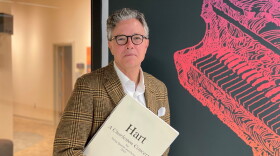 Ahead of his work's January 7th premiere, Edward Hart explains how he hopes to evoke the Lowcountry's checkered past and promising future through music.

© 2026 South Carolina Public Radio

Play Live Radio
Next Up:
0:00
0:00
Available On Air Stations


