


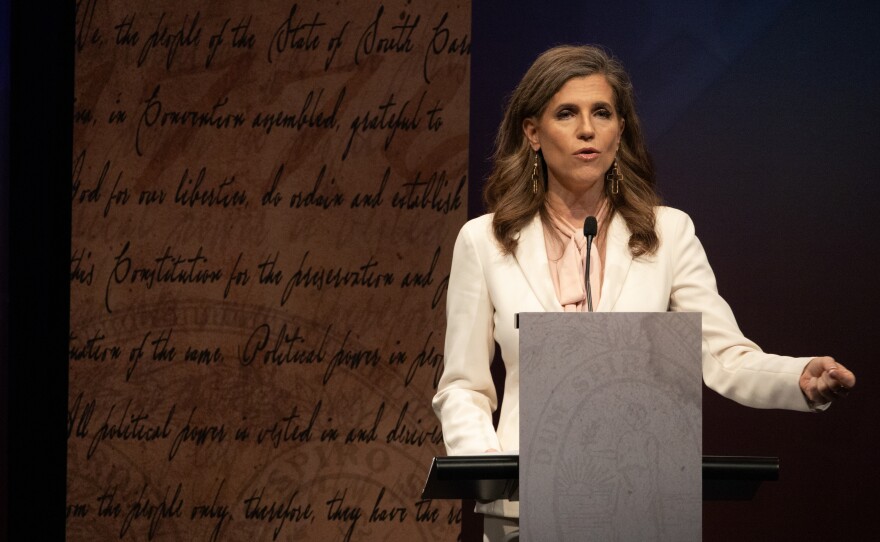
Three of six Republican candidates for governor spoke on immigration enforcement and election security, among other topics, at a Monday evening SCETV-hosted gubernatorial primary debate. The cordial conversation among candidates comes as voters continue to cast ballots during early primary voting, which ends June 5.
A trio of U.S. Rep. Nancy Mace, U.S. Rep. Ralph Norman and state Sen. Josh Kimbrell participated. Lt. Gov. Pamela Evette, Attorney General Alan Wilson and businessman Rom Reddy canceled ahead of the debate.
Evette, whom President Donald Trump endorsed for office Friday, said during the weekend that she would not participate in the debate. She instead hosted a free event in Greenville County's city of Travelers Rest for supporters to attend.
"I've been the most accessible, proactive candidate in this race. My goal is to bring my message to the people, not spar onstage for 'blood-sport' with RINO Never-Trumpers," she said in a May 31 social media post.
Reddy announced he would not attend the debate following Evette's decision. He, too, hosted a rally for supporters in Greenville County.
"This race is now a choice between a McMaster dynasty and something different," Reddy wrote on X, formerly Twitter, Sunday afternoon. "Since Pamela has elected to skip tomorrow's SCETV debate there is no longer a reason for us to attend."
Wilson was the final candidate to pull out of the event. He and his campaign said in a release that the lieutenant governor should not be skipping debates.
"Evette's pattern has become impossible to ignore. Every time voters are given an opportunity to hear directly from the candidates, she finds a reason not to show up and answer their questions."
Despite chatter from candidates on social media, the crux of the night's conversation was based in policy and promises; candidates spent nearly no time acknowledging each other or the three who did not attend.
The similarities
SCETV's Gavin Jackson asked candidates a slew of questions that ranged from office transparency to potential grocery and healthcare affordability alleviations.
Each candidate committed to publishing their weekly schedule, which is a practice that began under former Gov. Nikki Haley's administration. And all three said their actions as governor would match their promises on the campaign trail; the promise of action was woven in the candidates' answers throughout the hour of debate.
"The same concerns South Carolinians have about politicians saying one thing and doing another — same things I'm concerned about," Norman said while answering the first question of the night.
All three candidates committed to some form of tax cut, and Mace continually brought up her plan to cut the state income tax.
Mace and Kimbrell both displayed their displeasure with South Carolina's open primary structure. Voters do not have to align with a political party when registering to vote and are instead free to vote in whichever party's primary election on Election Day. Voters are limited to voting in one primary per election.
"The greatest threat to democracy is open primaries here in South Carolina," Mace said.
Mace said she would work with the Legislature and use the full extent of her power to help pass policy. The other candidates, too, shared a similar sentiment.
When it came to appointments, each candidate essentially said capability and character would help guide choices. Kimbrell singled out former South Carolina Department of Public Health Interim Director Dr. Edward Simmer as an example of a poor appointment.
Mace took Kimbrell's lead and showed her disapproval of acting DPH Director Dr. Brannon Traxler and the Department of Motor Vehicles' efficiency — alongside some unnamed longtime employees.
"If you keep putting the same people in charge, nothing is ever going to change," she said.
Immigration enforcement was across the board supported. And all candidates said congressional redistricting was needed.


The differences
Hemp-THC regulations, election security and diversity were the three ways in which the candidates particularly disagreed.
Norman said marijuana was a "gateway drug" that he was not in favor of expanding access to. Mace and Kimbrell said hemp product regulation was needed, and Kimbrell said he was in favor of expanding access to medical marijuana to help veterans with PTSD; Kimbrell, at least at surface level, was the least opposed to the furthering access.
"There's a lot of folks who use the THC drinks even to sleep," he said. "There's ladies at the Baptist church who take THC drinks even to sleep."
In the midst of early primary voting in South Carolina, Kimbrell said the state's elections were safe and secure. Mace wanted to see the state purge voter rolls more often to ensure an accurate database. Norman said the state's election did not meet a safe and secure standard.
The congressman wanted an audit of the South Carolina Election Commission.
Regarding diversity, Jackson asked the candidates about a recent Winthrop poll that said a plurality of South Carolinians believe having people of many races, nationalities and ethnic groups makes the country a better place. He asked if candidates agreed.
“The color of your skin or your ethnicity matters nothing to me. I want to know what you’re going to do," Norman said. "Are you competent in what you’re about to undertake, particularly when you’re being paid for with taxpayer dollars?”
Mace said she believed assimilation into the nation's culture had become an issue. She pointed at Michigan and Minnesota as examples of what her administration would prevent.
"But if you go to Minnesota, if you go to Michigan, you hear the Muslim prayer calls hour after hour after hour. That is not — those are not — our values here in America.”
Kimbrell shared Mace's view on culture assimilation but had a more personal answer about his wife, who was not born in the United States.
"I want people to come here and join our culture, not come here and try to tear it down. If you want to come to South County, be part of it, welcome. If you want to destroy it, get out," he said.
Kimbrell had not been invited to the final GOP-hosted Republican primary gubernatorial debate because of a polling threshold. He was the only candidate throughout the night to make multiple references to Lt. Gov. Evette and her absence.
"One of the things I would applaud Congressman Norman and Congresswoman Mace is for being here," Kimbrell said. "Behind us tonight you have the words of the Constitution, which starts with 'we the people,' not we the 30-second TV ad."
In a gaggle with the media after the debate, Kimbrell said he was prepared to back another candidate in the race, although he did not commit to an endorsement or to dropping out of the contest. He said he'd like to see Wilson or Reddy as governor should it not be him.
“The attorney general’s actually got a record. The lieutenant governor’s running around telling everybody, ‘Oh, I did all these things.’ You can’t do anything in South Carolina as lieutenant governor," he said. You can barely order Chipotle on an Uber app without permission from the governor."
Norman was the only candidate present who had announced a pick for lieutenant governor. South Carolina Freedom Caucus Founding Chairman Adam Morgan was Norman's running mate of choice. Morgan is a former state representative.
Watch the full debate below:
What comes next
The June 1 debate was the final scheduled chance for voters to hear from multiple GOP candidates in the same room before the election. More than 151,000 people had voted early as of 8:30 a.m. June 2. About 527,000 ballots were cast across the entire 2024 primary cycle.
Voters can cast an early ballot each weekday from 8:30 a.m. to 5 p.m. until Friday, June 5. A photo ID is required.
SCETV will host a Democratic gubernatorial primary debate June 3 at 7 p.m. State Rep. Jermaine Johnson, businessman Billy Webster and attorney Mullins Mcleod are the three candidates people can vote for in the Democratic primary election. Each has committed to Wednesday night's debate.
The primary election is June 9.
